Background
HyperTech is a sub-team of e-NABLE that works on projects commissioned by a counterpart team of medical students at the Carilion Clinic medical school.
The Child-Proof Gun Lock Project is one of these projects and is focused on addressing the pediatric crisis of accidental firearm injuries and fatalities in children from the ages of 3-5 in the Roanoke and Montgomery Country areas.
With gun-locks already on the market, we needed to figure out why they were not already being used by the parents of young children, and how we could create a design that would meet these user needs.
I contributed to primarily through researching the types of guns that were most common in the area and researching what designs and mechanisms made something “child-proof.” As a part of this process, I got in contact with the firearms specialist at the VTPD to get opinions on our design thinking and to confirm what firearms were most common in the area.
Defining User Needs
When trying to determine why current locks were not being used, we referred to online reviews and testimonials that the medical students gathered from parents that they had talked to about the issue.
The common threads were:
- If being used for home protection/emergency self defense, they wanted the gun to be easy to access
- Locks were hard to take off and put on
- The current locks were bulky
- They were worried that the locks would damage the gun
From these we defined our design requirements to be:
- Hard/Impossible for a child to open or break
- Easy for an adult to open
- Ideally not bulky
- Layer of protection between the lock and gun to make sure the lock was not damaged

Defining “Child-Proof”
To make a design that would be difficult for a child to open, I consulted designs of objects that were already considered “child-proof” on the market.
The most common thread in these designs was that all of them hinged on having developed fine motor skills to use them.
Using this as a design constraint, I conceptualized the idea of using a pinching lid design used on most pill bottles and having a box that covered the trigger and wrapped around the gun. The idea being that the pinching lock would be used at the top and the box would clasp around the gun with a hinge at the bottom.
This idea was iterated on further by other members of the team, and the project is still being worked on by them currently.
[When team website is updated I will add a link here!]
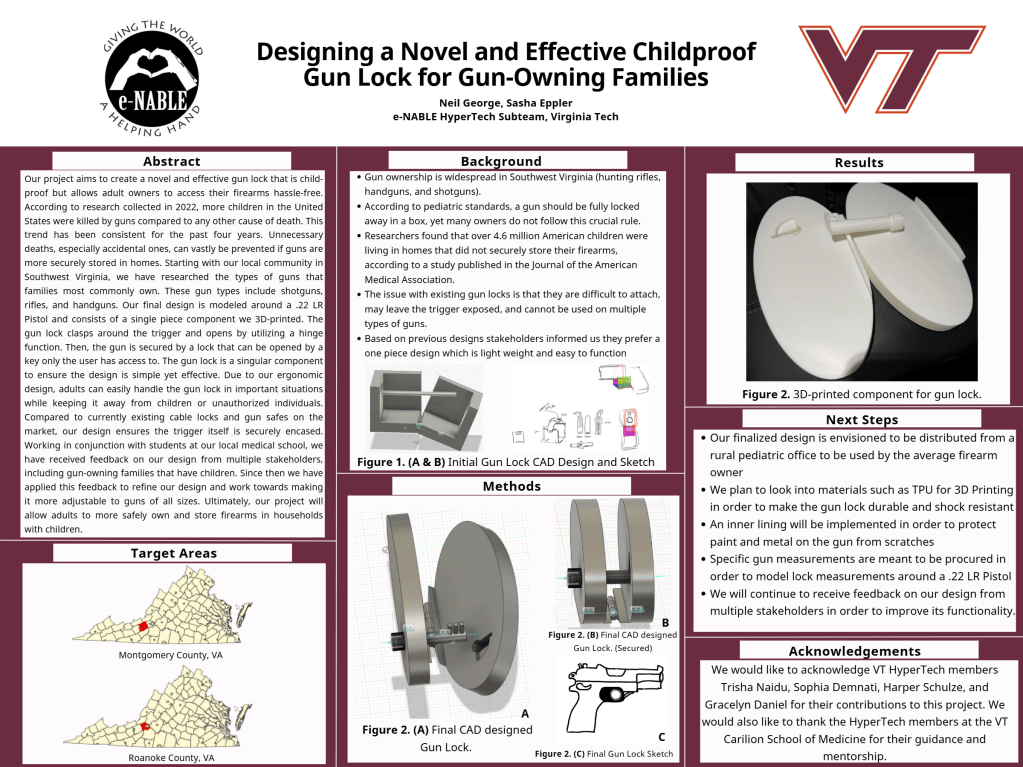
I was part of the presenting team for the project in April of 2025 at the NCUR conference, to the right is the poster that we presented.
Due to our stakeholders asking for the mechanism to not wrap around the top of the gun if possible, the design was shrunk to fit over the trigger exclusively. This allows the design to be more universally used on different guns and not exclusively the common Glock that our team was focusing on.
The childproof pill bottle design was decided to be used on the turning point of the key to the locking mechanism.
I left at this stage of the project, but the one improvement that I would immediately make to this design is making the part of the key that it gripped when turned larger and easier to use.
Alternative Design: Temporary Internal Jamming
One of the issues that we realized early on in this project is that there are a lot of different types of guns and they are all different in shape and size. With our aim initially being to have as universal of a design as possible (currently the team is focused on making variations on a design for each type of gun), I ideated on what could be a universal solution.
When looking into the anatomy of most firearms the process that results in firing a bullet is as such:
- Inserting ammunition (bullets)
- Usually in the form of cartridges for most automatics
- Loading ammunition into barrel
- Semi-automatic hand gun: Pulling back the rack
- Automatic rifle: Pulling back the slide
- Pulling the trigger
My initial thought process was: you can’t shoot a gun if you cannot load it, so my proposal was that we could create a device that would go inside of the loading area.
This design was eventually not considered going forward, as our stakeholders at the Carilion Clinic felt that having a locking mechanism that did not have any chance of actually jamming the gun was the best approach.
 Sasha E - Portfolio